How is it possible that, in an age of absolute media visibility and the unstoppable flow of information that surrounds us, treasures are literally hidden just a few steps away from us?
And what if, even if we ‘knew’ them, this were still not enough to ‘see’ them?
This is not a riddle from a weekly puzzle magazine, but a concrete example of the invisibility of local cultural heritage: in Verona’s Biblioteca Capitolare, a 1,500-year-old parchment manuscript is preserved, containing substantial portions of the works of Virgil with scholia, as well as of Titus Livius and a few late-antique texts.
Could such an important poet have been so well hidden away in a book at the Capitolare that not even Dante, who lived in Verona for some years, ever had the chance to leaf through it? How is that possible?
The answer, if you’ll pardon the pun, is right before our eyes: Codex XL (38) of the Capitolare (let’s call it by its name) is a palimpsest in which the erased late-antique writings are overwritten by a minuscule script dating no later than the early 8th century, containing Gregory the Great’s Moralia in Iob. When Dante was living in Verona, that manuscript had been illegible for centuries.
The manuscript holds exceptional philological value as one of the seven surviving codices Vergiliani antiquiores, i.e., early witnesses to the Virgilian corpus dating from the 4th to the 6th centuries AD (the section containing Virgil dates from the late 5th century). Most importantly, its set of scholia, rich in citations from Greek and Latin authors and references to previous commentators on Virgil, is unique to the Veronensis. And it must have been precisely these highly erudite scholia that caught scholars’ attention during the nineteenth century; lacking alternatives, they made extensive use of various chemical reagents to decipher the ancient script, thereby complicating the reading of both script layers.
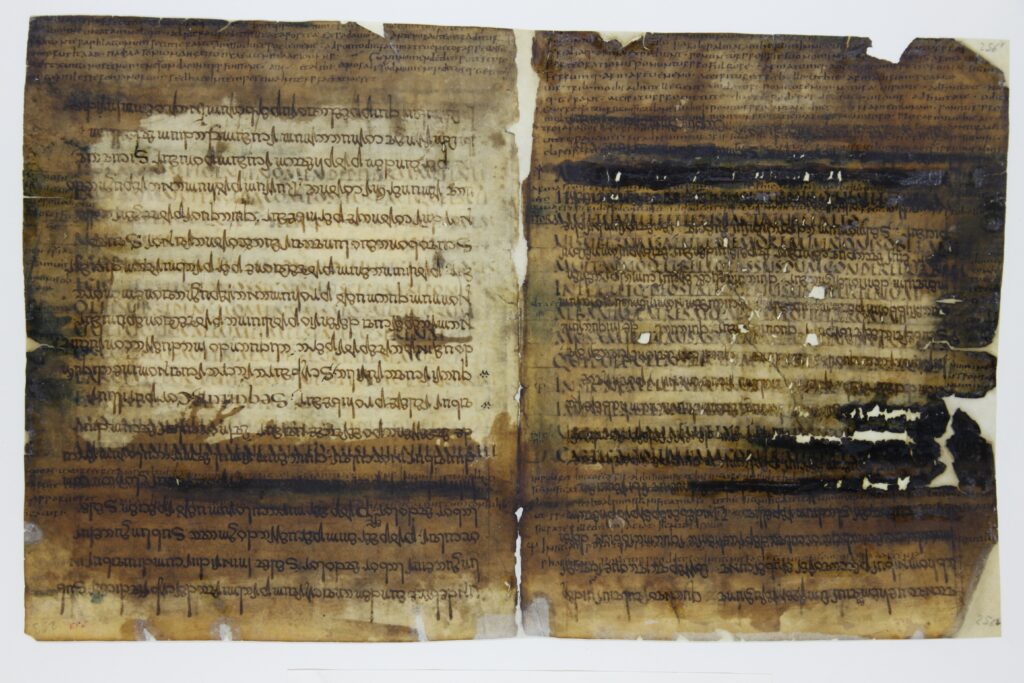
Folio 256v (on the right, rotated by 180°) from ms. XL (38), containing the beginning of the Aeneid. It is easy to see that reagents are used on a massive scale.
Nowadays, we approach palimpsests using non-invasive methods, such as Multispectral Imaging (MSI). MSI observes objects at selected wavelengths of the electromagnetic spectrum that are beyond the capabilities of the human eye. Different materials on the parchment surface respond differently under different lighting conditions and can reveal features otherwise invisible.
Following a four-month digitisation campaign in 2024, the Verona branch of AntCom, supported by the LaMeDan lab, has produced a complete set of multispectral images. So, can we now ‘see’ Virgil’s text, which was first erased by human hands and then eroded by the reagents?
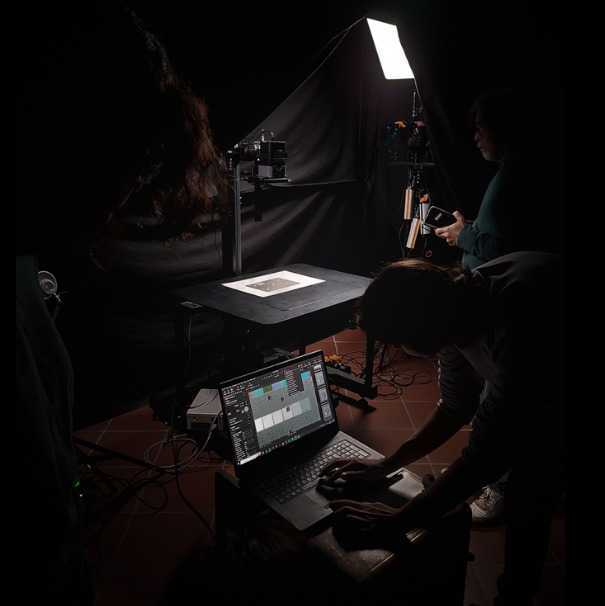
Calibrating the Phase One camera at the Capitolare.
In fact, we need to go one step further and carry out image post-processing, a complex task that requires expertise and time, and that works all the better the more specific and limited the area to be visualised is. Some areas will be amenable to improvement; others will not.
So, the question we must always ask ourselves is: who ‘sees’? Is it perhaps the experts, the scholars? Certainly, but with what reservations regarding the potential contribution of the only codex antiquior, which remains little investigated due to its precarious condition? In short, expert philologists might argue that a complete transcription is not worth the effort.
At this point, a change of perspective was called for: generosity, enthusiasm, a slow, calm yet focused gaze: perhaps this is what we need – we told ourselves in Verona! – to examine once more, after such a long time (Mario Geymonat in his 1973 critical edition, revised in 2008), the troubled Veronese parchments. And that is what we did: it was precisely the search for a fresh perspective that prompted the Verona team to propose an unusual challenge to high schools where Latin is taught: to actively involve citizens in transcribing Virgil’s works from the palimpsest manuscript of the Biblioteca Capitolare, testing the multispectral images produced by the Verona unit.
Citizen Science, a cornerstone within AntCom, is the active participation of citizens in scientific processes that generate new knowledge or understanding. The application of Citizen Science principles to the Humanities is known as Citizen Humanities. The institutional context of the project was that of the Department of Cultures and Civilisations’ Public Engagement and the so-called ‘School-to-Work Training’ (Formazione Scuola-Lavoro) activities for schools, which aim to integrate the school environment with social, cultural, and professional contexts to develop transversal skills and inform students’ career choices.
The response exceeded expectations: around 60 students from nine schools in Verona and the surrounding area, as well as from Mantua (the home of Virgil!), answered the call and were coordinated by one teacher from each school:
Verona – Educandato Statale Agli Angeli; coordinator: Anna Maganuco.
Verona – Liceo Statale Scientifico «Galileo Galilei»; coordinator: Silvia Alberti.
Verona – Liceo Scientifico «Girolamo Fracastoro»; coordinator: Federica Perotti.
Verona – Liceo Classico e Liceo Linguistico «Scipione Maffei»; coordinator: Claudio Baschera.
Verona – Liceo Scientifico «Angelo Messedaglia»; coordinator: Giorgia Totola.
Verona – Liceo delle Scienze Umane «Lavinia Mondin»; coordinator: Pietro Fiorini.
Mantova – Liceo Classico «Virgilio»; coordinator: Milena Bernardelli.
San Bonifacio – Liceo Classico e Scientifico «Guarino Veronese»; coordinator: Daniela Sordato.
Villafranca – Liceo Statale Classico e Scientifico «Enrico Medi»; coordinator: Claudia D’Arcamo.
From March to May 2026, the young transcribers (aged from 16 to 19) were welcomed twice a week to the University’s computer rooms. The project opened with an intensive training phase, during which students received an introduction to philology and critical editions from Paolo Scattolin, an overview of the Virgilian manuscript tradition from Paolo De Paolis, an introduction to the physics of light and Multispectral Imaging from Giacomo Marchioro, and a hands-on tutorial on the transcription tool and workflow on Transkribus from Stefano Bazzaco and AntCom’s PhD students Panagiotis Leontaridis and Konstantina Tsakona.
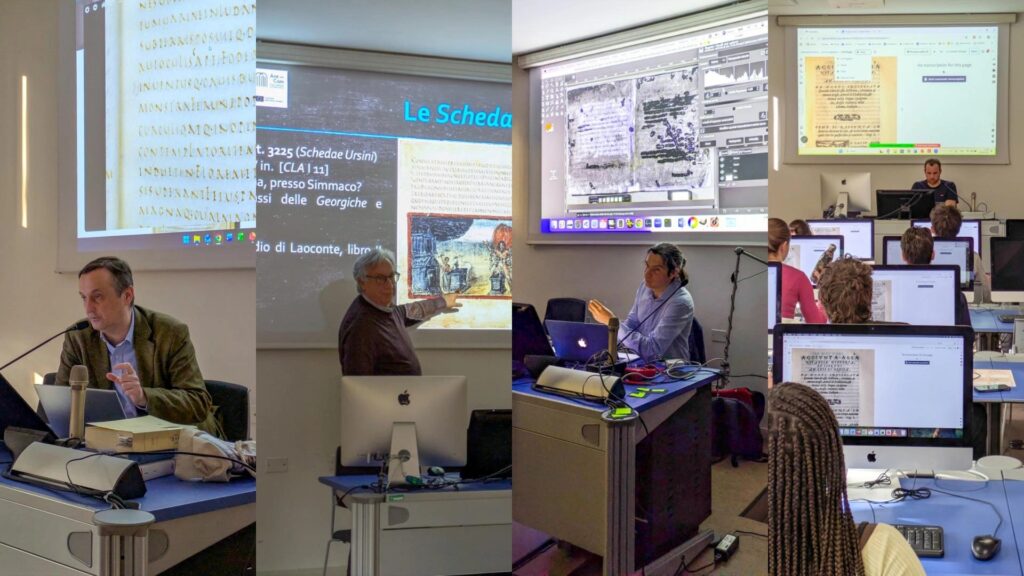
Training sessions.
The highlight of the training was the session hosted by palaeographers Ilaria Ferrari and Valeria Nicolis (Biblioteca Capitolare di Verona), during which students had the opportunity to examine in person a selection of palimpsest folios and take part in an immersive laboratory on designing capitalis rustica, the elegant script of the Virgilian undertext.
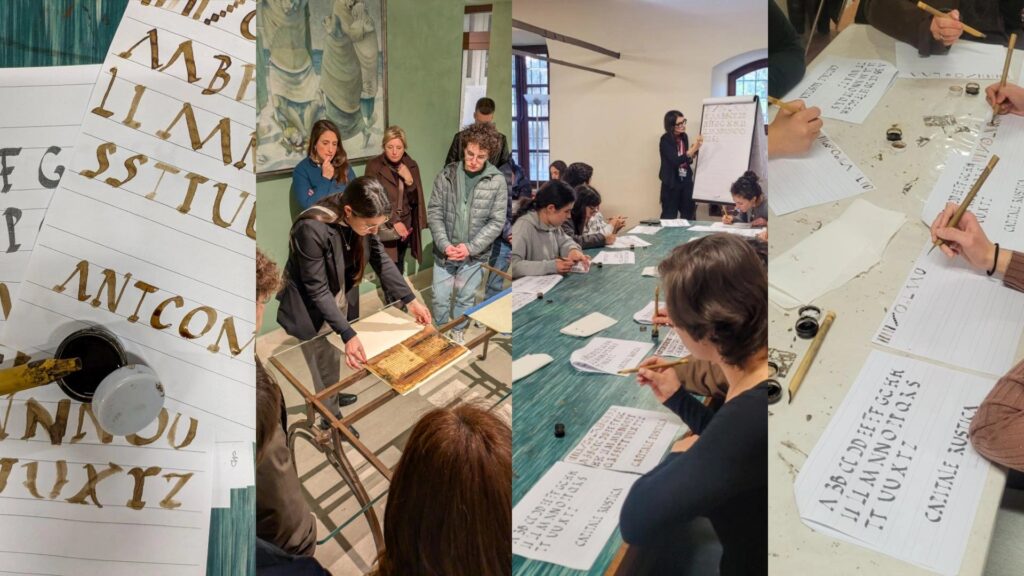
Palaeography session at the Capitolare.
Before starting the transcription of Virgil, students prepared by practising the workflow on the digital reproduction of the Vatican Virgil (Vat. Lat. 3225), a late-antique manuscript, not a palimpsest, written in the capitalis rustica.
For the practical phase, students were divided into 25 teams, each assigned a bifolio side. They were equipped with dual screens (one for the transcription interface and another for displaying the processed Multispectral images), a sample of the capitalis rustica, the relevant pages of Geymonat’s 2008 revised edition of Virgil, and transcription and tagging guidelines for using Transkribus. The recommended tags encoded abbreviations, corrections, deletions, additions, uncertainty, and loss of text, mainly due to reagent damage. They were inspired by standard transcription practices, with Text Encoding Initiative (TEI) compliance in mind for standardized, properly encoded, interoperable output.
To keep the task simple while working on such a complex manuscript, students were asked to work only on the Virgilian undertext, ignoring the overtext and surrounding marginal commentary. They first drew the text regions and lines, then transcribed verse by verse, consulting the Multispectral Images, debating the readings, and comparing them with Geymonat’s readings, who at the time (early 1970s) did not have the advantage of MSI.
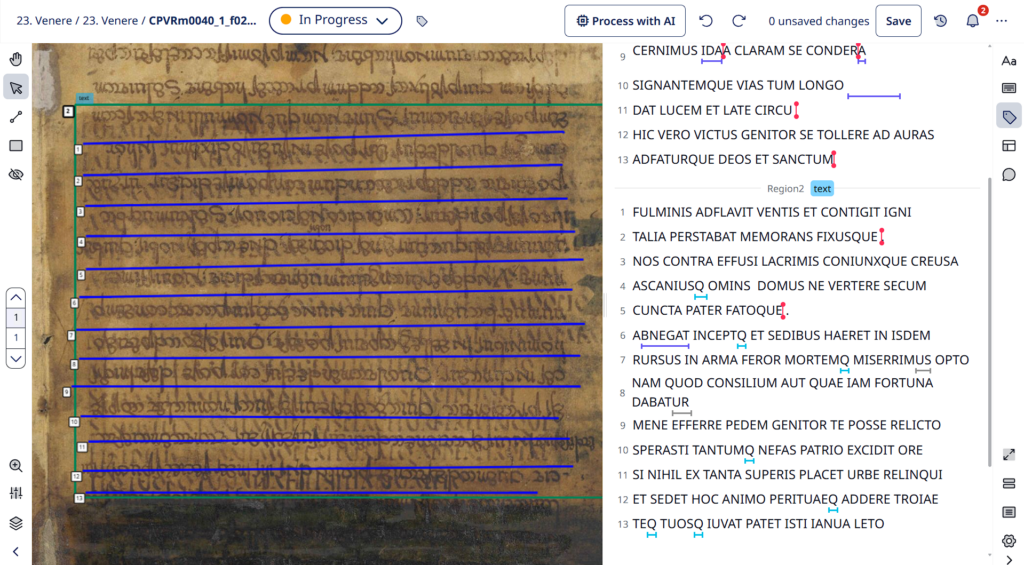
Transcribing the palimpsest on Transkribus.
Any corrections, additions, deletions, and, most importantly, the doubt or inability to transcribe at the character, word, or verse level, were encoded using the appropriate tags, along with the reasons that caused it.
In total, 25 out of 50 bifolios with Virgilian undertext were transcribed. These transcriptions are currently undergoing expert review for quality and uniformity. The outputs will be coauthored by the participating students and published on the project’s Zenodo.
The project concluded on 29 May 2026 with an international seminar at the University of Verona, dedicated to the students. It hosted specialists in the Virgilian exegetical tradition: Maria Luisa Delvigo (University of Udine) explored Servius as a commentator who portrayed Virgil as a poet ‘beyond reproach’; Alessandro Garcea (Sorbonne University) elaborated on the late-antique scholar and commentator Servius as a vehicle for the broader cultural memory of the Romans; and Angeliki Boikou (Sorbonne University) shed light on the fragments of Latin poetry preserved in the Scholia Veronensia.
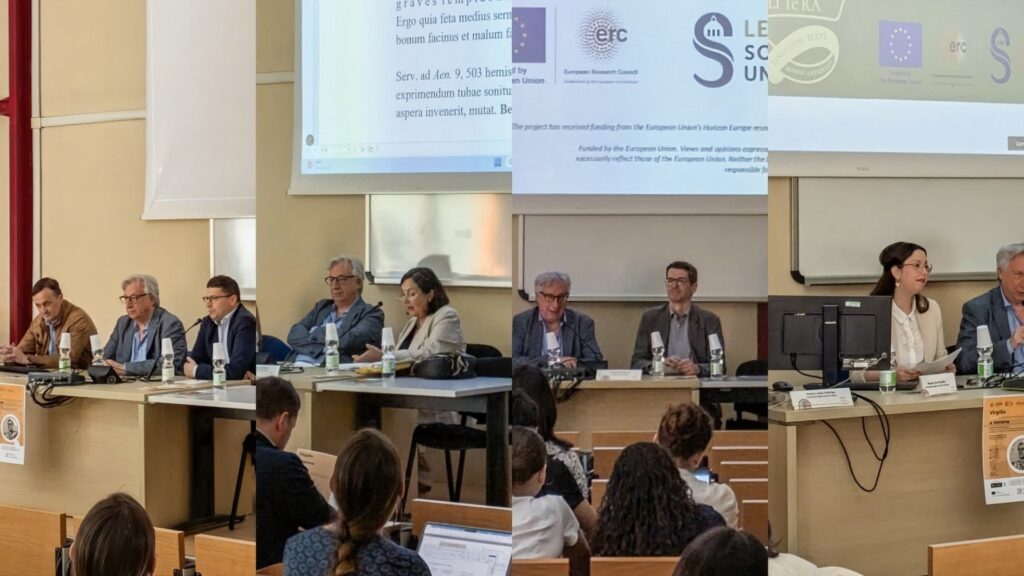
Virgilio (invisibile) a Verona: the final seminar.
The highlight of the event was the students’ presentations in the presence of their teachers, classmates, friends, and relatives (and academics, of course!). Each school selected one or two case studies to elaborate on, then elected a representative who presented any noteworthy deviations from Geymonat’s critical edition.
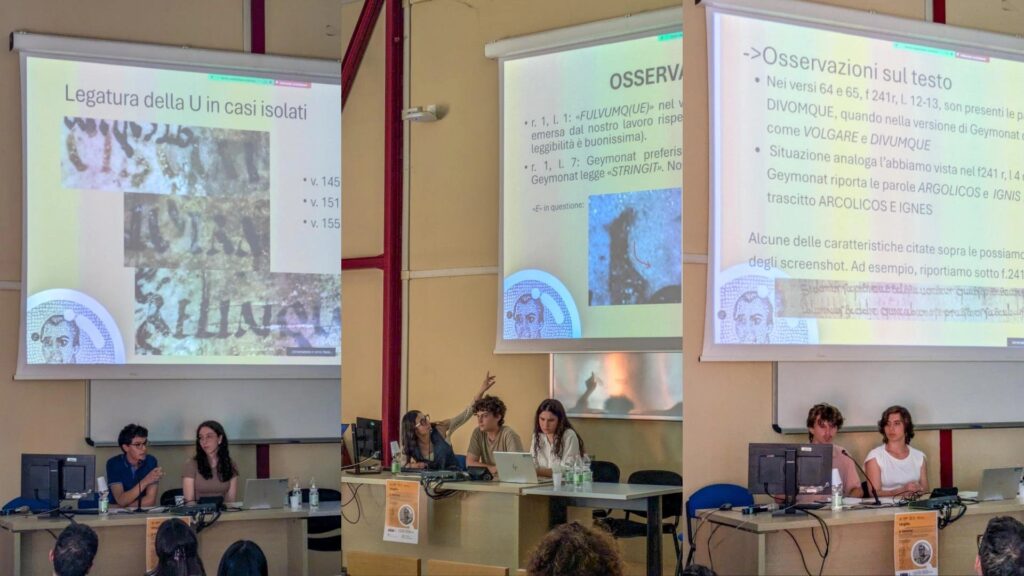
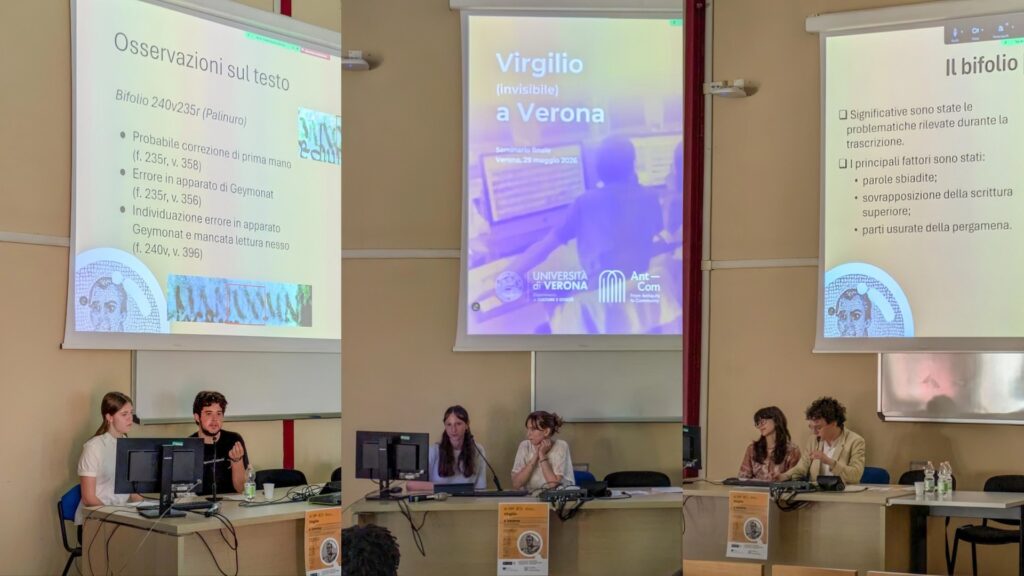
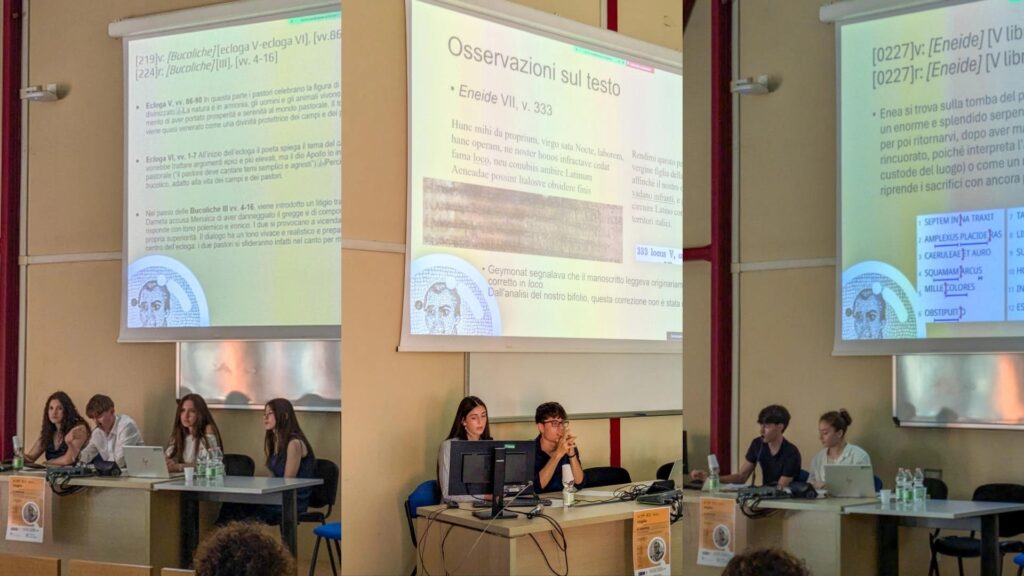
Virgilio (invisibile) a Verona: the students’ presentations.
Depending on the case, the participants either confirmed or refuted Geymonat’s transcription, but they also improved it, like when, after some post-processing performed by Panagiotis Leontaridis, they discovered the original title of Ecloga 6; at times, anyway, they were stumped by sequences of letters that were no longer legible in the palimpsest, in particular certain supra lineam corrections that the editor claimed to have deciphered just over 50 years ago.

Traces of the title of Virgil’s Ecloga 6 in the palimpsest XL (38): Faunorum Satyrorum Silenorum Dilectatio.
This may mean that the parchments are continuing to deteriorate and, consequently, that the transcription produced by Virgilio (invisibile) a Verona is set to become a new and indispensable link in our understanding of the transmission of the poet’s works in late antiquity. AntCom and the enthusiastic students who shared in this adventure have, quite rightly, entered the ‘history of the tradition’.
Prof. Scattolin and Prof. Baschera ponder the future of ms. XL (38).